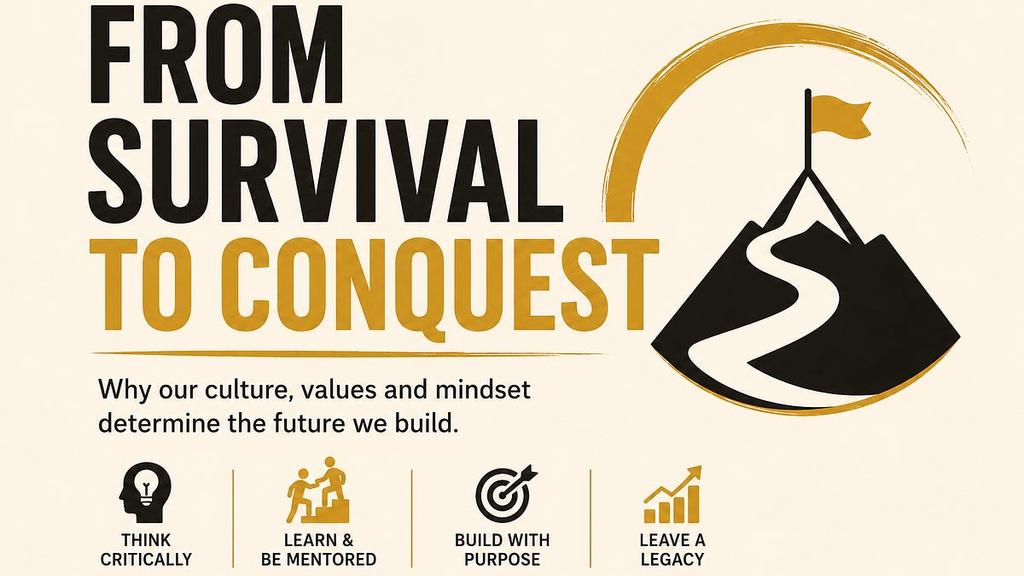
From Survival to Conquest
The Poverty of Survival
If you're one of the inhabitants of this surviving hemisphere, it becomes increasingly evident that our declining economic and developmental realities are exposing something far deeper than failed systems. They are revealing the state of our collective culture.
Mediocrity has gradually become normal. Not because we lack intelligence or innovation, but because our commitment to applying both has weakened. We speak passionately about transformation, yet our actions rarely reflect the futures we claim to desire.
Somewhere along the line, many of us abandoned conviction for conformity. We became captivated by the quiet propaganda of "I too must belong." Instead of pursuing purpose, we pursue acceptance. Instead of building identity, we imitate popularity. The result is a society that celebrates participation more than contribution.
The religious landscape offers a familiar example. While faith remains one of humanity's greatest sources of hope and moral guidance, our obsession with spiritual performance has, in many cases, displaced practical responsibility. We increasingly search for supernatural solutions
to problems that demand disciplined thinking, education, innovation, and collective action. A continent cannot pray its way into development while neglecting the work that development requires.
Our relationship with culture has suffered a similar fate. In our eagerness to appear modern, we often dismiss the very traditions that once produced disciplined families, resilient communities, and responsible leadership. Modernity should not require the destruction of identity. It should refine it.
Culture was never meant to imprison progress. It was meant to provide the foundation upon which progress stands.
Among the greatest gifts our cultures offered were mentorship, apprenticeship, patience, and the deliberate transfer of wisdom from one generation to another. They taught us that greatness is inherited through learning before it is expressed through achievement.
Today, however, mentorship is frequently viewed as unnecessary, outdated, or even oppressive. We celebrate independence while quietly abandoning the guidance that has shaped every enduring civilization in history. In doing so, we exchange accumulated wisdom for repeated mistakes.
Life has never rewarded mere existence. It rewards preparation.
You cannot sustain what lacks the capacity to strengthen you. Before influence comes discipline. Before leadership comes formation. Before purpose comes understanding.
Yet survival has rewritten our definition of strength.
Many now measure resilience by how much suffering they can endure. Survival has become a badge of honor. While endurance deserves respect, it remains incomplete. Surviving today does not automatically prepare us to build tomorrow.
A people consumed only by survival eventually lose the ability to imagine beyond the next obstacle. Their vision shrinks to immediate needs. Their ambitions become reactive rather than creative. Their future is traded for the comfort of simply making it through another day.
This is the silent poverty of survival.
It convinces people that staying alive is the same as living well. It persuades societies that endurance is equal to progress. But history has never been shaped by survivors alone. It has always been shaped by builders, thinkers, reformers, innovators, and those courageous enough to imagine realities that did not yet exist.
Survival is necessary.
But survival is only the beginning.
Civilizations are not built by those who merely endure. They are built by those who transform endurance into vision, vision into action, and action into legacy.
Perhaps the question before Africa—and before every one of us—is no longer whether we can survive.
The question is whether we still possess the courage to conquer.
Edit this block to edit the article content or add new blocks...
Post a comment